




















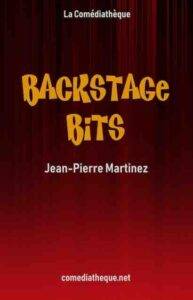
A sketch comedy by Jean-Pierre Martinez
English translation by the author
Many different characters (males or females)
The ups and downs of the noble profession of acting, portrayed through around fifteen short scenes that humorously highlight the quirks and pitfalls of what could also be considered the oldest profession in the world.
This text is available to read for free. However, an authorisation is required from the author prior to any public performance, whether by professional or amateur companies. To get in touch with Jean-Pierre Martinez and ask an authorisation to represent one of his works CONTACT FORM
| DOWNLOAD PDF FOR FREE |
 |
Behind the Curtain: The Comedy of Theatre
Fifteen sketches take us behind the curtain or the camera, to the place where actors wait for a role, a cue, a take or a curtain call. Elusive agents, uncertain auditions, anonymous extras, ageing stars and idle performers make up a small world governed by insecurity and the hunger for recognition. Far from the prestige usually associated with the profession, an actor’s daily life appears above all to consist of waiting, compromise and hopes that are often disappointed.
Each sketch grows out of a theatrical convention taken literally or pushed to the point of absurdity: “Quiet on set!” condemns the actors to silence, two performers confuse Hamlet with A Streetcar Named Desire, while dubbing and the original version combine to produce a conversation that has become incomprehensible. These shifts create a constant play within the play: the performance breaks down before our eyes, and its failures become the very material of another performance.
The satire targets the illusions, vanities and rivalries of the profession, yet it is also infused with genuine affection for those who have chosen to perform. Behind the stars’ egos and the actors’ bad faith lie the fear of unemployment, the anxiety of no longer being desirable and the vulnerability of those whose existence depends on the approval of a producer, a director or the audience. Even fame offers no protection against oblivion or against being trapped in a single role.
The collection thus explores the actor’s paradox: must one become the character, or merely create the illusion of doing so? From Molière to Diderot, from Stanislavski to the Actors Studio, theatrical theory emerges at the very heart of the comedy. Right up to the final “cut”, the boundary between role and person remains uncertain: after spending a lifetime waiting to be called upon to perform, the actor may discover that they no longer quite know how to live once the show is over.