




















A sketch comedy by Jean-Pierre Martinez
English translation by the author
One or several couples
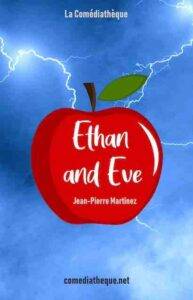
A man and a woman in their garden. Are they the first or the last? Are they even a couple? Only God would know if He weren’t already dead…
This text is available to read for free. However, an authorisation is required from the author prior to any public performance, whether by professional or amateur companies. To get in touch with Jean-Pierre Martinez and ask an authorisation to represent one of his works CONTACT FORM
| DOWNLOAD PDF FOR FREE |
 |
A Little Mythology of Life Together
In a garden that may be Eden, a desert island, a holiday retreat or the last refuge before the apocalypse, Alban and Ève reenact between them the whole history of humankind. Across fourteen sketches, they are by turns the first couple, an ordinary married pair or the last survivors. Each scene places them in a new situation, yet always facing the same difficulty: living together in a world where no one else exists.
The play does not unfold through a continuous plot, but through a series of variations. Each blackout erases the previous situation, while the garden, the apple, the couple’s isolation and the possible appearance of a third person provide unity throughout. The dialogue is driven by misunderstandings, lines of reasoning pushed to the point of absurdity, and collisions between metaphysical questions and trivial concerns. A sexual proposition can therefore determine the future of the species, while an election with only two voters is enough to expose the dead ends of democracy.
Reduced to two characters, the couple becomes a miniature society. It concentrates within itself questions of desire, reproduction, work, power, ecology, ageing and death. Stripped of all solemnity, the myth of origins reflects the most contemporary anxieties. Even the apocalypse takes the form of one final domestic argument over the last apple: it is precisely from this contrast between the vastness of what is at stake and the banality of the exchanges that both the comedy and the depth of the text emerge.
Yet beneath the black humour, the play does not reduce humanity to its contradictions. Alban and Ève grow bored, lie to each other and quarrel, but remain bound together by their inability to live without one another. The option of assigning the roles to several different couples reinforces this universal dimension: this is no longer the story of one man and one woman, but the endless variations of the same human duo, from the beginning of the world to its disappearance.