



















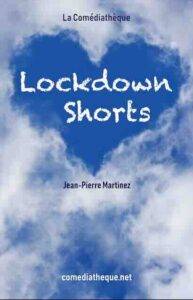
A sketch comedy by Jean-Pierre Martinez
English translation by the author
Many different characters (males or females)
Inspired by the Coronavirus health crisis.
Cast
16 characters
All roles may be played by either men or women.
For 2 to 16 performers (men and/or women).
This text is available to read for free. However, an authorisation is required from the author prior to any public performance, whether by professional or amateur companies. To get in touch with Jean-Pierre Martinez and ask an authorisation to represent one of his works CONTACT FORM
| DOWNLOAD PDF FOR FREE |
 |
The song from the play. Lyrics and music: Jean-Pierre Martinez. This song may be used as part of a stage production, upon simple request to the author and without any additional fees. The audio file is available upon request, subject to prior authorization from the author for the use of the play’s text.
Lockdown as a Mirror of All Our Confinements
Across sixteen sketches, the play captures situations born out of the health crisis before pushing them towards absurdity and dystopia. Travel permits, vaccines, masks, remote working, isolation and the reopening of cafés first create an immediately recognisable world. Gradually, however, this reality tips into a future where viruses talk to one another, human beings serve as guinea pigs, and the organs of condemned prisoners become spare parts in a new economy.
Lockdown is not merely the subject of the collection: it becomes its dramatic principle. The characters are almost always confined in pairs — within a couple, a hospital room, a telephone conversation or a prison cell. They try to communicate, yet remain trapped by their fears, their convictions and an official language that has become almost impossible to understand. The short-dialogue format brings this solitude into sharp relief, while the highly flexible casting makes it possible to stage the collection with anywhere from two to thirty-two performers.
The comedy is driven by the subversion of medical, administrative and media language. A vaccine attends a job interview, two viruses compare their careers, and the loss of taste becomes an epidemic of bad taste. Behind these reversals lies a satire of political rhetoric, surveillance, the pharmaceutical industry and conspiracy theories. The crisis acts as a revealing agent: it exposes the fragility of couples, the loneliness of individuals and the absurdities of the “normal life” everyone nevertheless claims to want back.
As the sketches unfold, health-related confinement takes on a broader meaning. It becomes social, political, economic and ultimately existential. The final scene brings this reflection back to theatre itself, an art based on collective presence that was particularly threatened by the closure of venues. Faced with the possibility of a final performance, actors and audience become aware of what still binds them together: the fragile privilege of being gathered in the same place, at the same moment, before the lights go out.