




















Monologues by Jean-Pierre Martinez
English translation by the author
Poetic, psychoanalytic, and humorous monologues
Without delving into philosophy or reclining on a psychoanalyst’s couch, during moments of idleness or sleepless nights, we all contemplate the meaning of life. Well, at least the meaning of our own lives. We ask ourselves small questions without substantial answers. Or even big questions without a tiny hint of an answer. Unless the daily routine suddenly derails, sending us, dizzy, to the edge of the unfathomable abyss of meaning. A troubled depth can then surface, revealing, amidst the waves, like a sea monster, a one-way street… which constitutes the tragicosmic essence of our everyday existences. A comical dive into the depths of our superficial lives…
This text is available to read for free. However, an authorisation is required from the author prior to any public performance, whether by professional or amateur companies. To get in touch with Jean-Pierre Martinez and ask an authorisation to represent one of his works CONTACT FORM
| DOWNLOAD PDF FOR FREE |
|
|
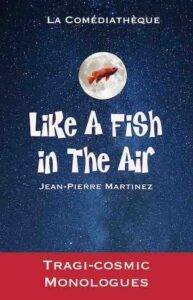
The Comic Vertigo of Being Alive
Like a fish in the air brings together twenty-three monologues in which an apparently ordinary individual tries to understand what they are doing there — on stage as much as in life. A sleepless night, a car journey, a session with a therapist, a conversation about love or a simple travel memory is enough to trigger a train of thought that quickly moves far beyond its starting point. The aim is not to provide philosophical answers, but to give voice to a mind in motion, searching for meaning while doubting that any meaning may truly exist.
The writing moves through associations of ideas, shifts in meaning and unexpected connections. A familiar expression is taken literally, an everyday anecdote suddenly opens onto infinity, then a joke abruptly brings thought back down to its most trivial level. Housework leads to a political theory, a snow globe becomes a miniature model of the universe, and a projector breakdown turns into a metaphor for existence. This digressive thinking always seems on the verge of losing the thread, yet its detours gradually reveal a hidden coherence. The comedy arises precisely from this constant movement between the trivial and the metaphysical.
Behind the humour lies a persistent unease: how can one inhabit a world to which one never feels entirely suited? The title twists the expression “like a fish in water” to suggest a being deprived of its natural element, condemned to search for the air that will allow it to breathe. The monologues thus explore identity, ageing, love, loneliness, death, God, social inequality and memory. Travel occupies a central place, yet rarely leads towards a certain destination. One drives in order to delay arrival, crosses the world only to miss an appointment, or tries to return to an origin that may exist only in the story one tells oneself about it.
The monologue form turns the audience into a silent partner. Depending on the text, it becomes a psychoanalyst, a hitchhiker, a classroom of pupils, an assembly of citizens or simply a confidant. Solitary speech thus takes on the paradoxical form of a dialogue: the character questions the audience, anticipates their reactions and uses their silence to set their own thoughts in motion again. The final text gives the collection a more intimate resonance by turning writing into a homeland and the return to oneself into an odyssey. Beginning with the fear of being nobody, the speaker eventually comes to recognise themselves as “the author of their own days”. Between these two points, Comme un poisson dans l’air transforms existential disarray into theatrical material: a way of laughing at the absurd in order, somehow, to keep breathing.