A comedy by Jean-Pierre Martinez
English translation by Anne-Christine Gasc
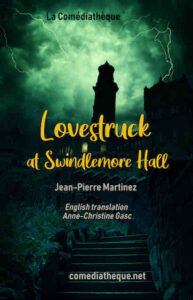
Desperate to regain some of her family’s lost prestige, Baroness Swindlemore von Hustlestein is in search of a rich and easily pleased suitor for her daughter, who isn’t much to look at. She thinks she has found the perfect candidate …
A comedy aimed at ridiculing the importance given in our society to the appearance of respectability and wealth. The comedic principle here is based on an unexpected reversal, with the scammers ultimately getting scammed by their presumed victims. To quote Shakespeare: « hoist with his own petard. »
This text is available to read for free. However, an authorisation is required from the author prior to any public performance, whether by professional or amateur companies. To get in touch with Jean-Pierre Martinez and ask an authorisation to represent one of his works CONTACT FORM
The song from the play. Lyrics and music Jean-Pierre Martinez. This song may be used as part of a stage production, simple request to the author and without any additional fees. The audio file is available upon request, subject to prior authorization from the author for the use of the play’s text.
Love Is Blind… Marriage Opens Its Eyes
At Casteljarnac Castle, Baroness Carlota is ruined and desperately trying to save appearances as well as her estate. She wants to marry her daughter Marika to Franck, a supposedly blind billionaire suffering from a terminal illness, who is looking for a young woman from a respectable family. The arrangement seems perfect: he brings the money, while they provide the name. But the arrival of Maria, a new maid who may in fact be the Baroness’s real daughter, unsettles this fragile arrangement and sets off a series of revelations.
The play is built around a succession of reversals. Maria threatens to take Marika’s place, before Franck and Maria are revealed to be accomplices in a scam. They then discover in turn that the castle is mortgaged, the portraits are fake and even the Casteljarnac family’s nobility was invented. Everyone therefore tries to deceive everyone else, only to discover that they themselves have been fooled. The farce progresses through constant shifts in position: masters and servants, heirs and impostors, victims and swindlers continually exchange roles.
Beneath the conventions of boulevard comedy, Lovestruck at Swindlemore Hall plays with a simple idea: in this world, social identity is nothing more than a performance. Title, wealth, parentage, disability and respectability have value only for as long as other people believe in them. The epilogue takes this logic to its conclusion by establishing a form of “rotating democracy” in which Marika and Maria take turns playing the Baroness, the wife and the maid. Rather than restoring order once the lies have been exposed, the play turns imposture itself into the new equilibrium.