.

Testa o Croce

Una commedia di Jean-Pierre Martinez

Traduzione dell’autore

2 personaggi : 2U

Alex e Fred sono due attori, un tempo amici, che non si vedono da anni. Col passare del tempo, la loro amicizia si è trasformata in una rivalità al tempo stesso professionale e sentimentale. Uno dei due ha dato appuntamento all’altro sul palcoscenico di un teatro, nel tentativo di riallacciare il filo di un’amicizia svanita insieme alla loro giovinezza. Questo tentativo di riconciliazione si trasformerà in un regolamento di conti, prima di sfociare forse in un progetto inatteso.


Questo testo è concesso gratuitamente alla lettura. Prima di ogni rappresentazione pubblica, professionale o amatoriale, dovete ottenere l’autorizzazione della SIAE: www.siae.it 


Modulo di contatto


DOWNLOAD GRATUITO PDF

Altre opere teatrali in italiano


Biografia di Jean-Pierre Martinez

Nato nel 1955 a Auvers-sur-Oise, Jean-Pierre Martinez calca le scene come batterista in diversi gruppi rock, prima di diventare semiologo pubblicitario. Diviene poi sceneggiatore per il piccolo schermo e torna in scena come autore di teatro. Ha scritto una sessantina di commedie alcune delle quali (in particolare Vendredi 13) sono già considerate dei classici. Oggi è uno degli autori contemporanei più interpretati in Francia e molte delle sue opere teatrali sono state tradotte in spagnolo ed in inglese. È laureato in Letteratura Spagnola e Inglese (Sorbona), in Linguistica (École des Hautes Études En Sciences Sociales) in Economia (Institut d’Études Politiques de Paris) e in Sceneggiatura e produzione audiovisiva (Conservatoire Européen d’Écriture Audiovisuelle). Jean-Pierre Martinez ha scelto di proporre i testi delle sue commedie in scaricamento gratuito sul suo sito La Comédiathèque : http://comediatheque.net

Testa o Croce Lire la suite »

Silvester in der Leichenhalle

Zum Autor

Jean-Pierre Martinez, geboren 1955 in Auvers-sur-Oise bei Paris, hat seine ersten Bühnenerfahrungen als Schlagzeuger verschiedener Rockgruppen gemacht. Nach Studium und eigener Lehre von Text- und Bildsemiotik an sozial- und theaterwissenschaftlichen Hochschulen (Ecole Pratique des Hautes Etudes en Sciences Sociales, EHESS; Conservatoire européen d’écriture audiovisuelle, CEEA) wurde er in der Werbebranche tätig, verfasste nebenher schon bald Drehbücher für das Fernsehen und kehrte schließlich als Theater-Autor und Dramaturg an die Bühne zurück.

Martinez zählt zu den produktivsten und meistgespielten der heutigen Theater- und TV-Drehbuchautoren Frankreichs und des französisch-sprachigen Auslands. Bis dato hat er an die 100 TV-Drehbücher und mehr als 85 Komödien verfasst, von denen einige zu Klassikern geworden sind (Vendredi 13 oder Strip Poker). In englischer und spanischer Übersetzung werden seine Theaterstücke regelmäßig auf Bühnen in Nord- und Lateinamerika gespielt. Für den Erfolg der Theaterstücke von Jean-Pierre Martinez steht die Zahl von jährlich über 2.000 Aufführungen seiner Stücke, die inzwischen in 12 Sprachen übersetzt vorliegen – jetzt auch auf Deutsch.

Um seine Komödien interessierten Theatergruppen nahezubringen, hat Martinez sie zum freien Download auf einer eigenen Internet-Plattform eingestellt: La Comédiathèque, comediatheque.net. In Papierform (zum Preis der entsprechenden Fotokopien) können die Texte über die Webseite The Book Edition bestellt werden. Die Rechte für die Bühnenaufführung können / müssen über die Verwertungsgesellschaft SACD erworben werden.


Alle Stücke von Jean-Pierre Martinez können gratis von seiner Webseite heruntergeladen werden.


In deutscher Übersetzung liegen folgende Theaterstücke von Jean-Pierre Martinez vor:

Das Werk einschließlich aller seiner Teile ist nach den Bestimmungen über geistiges Eigentum urheberrechtlich geschützt. Jede Verwertung des Werks außerhalb der engen Grenzen des Urheberrechtsgesetzes und ohne Einwilligung von Autor und Übersetzer ist unzulässig und strafbar und kann zu hohen Schadensersatzansprüchen führen.

PDF GRATIS HERUNTERLADEN

Der vorliegende Text möchte Sie zur Lektüre einladen.

Wenn Sie ihn öffentlich darbieten möchten – gleich ob auf einer etablierten Bühne oder in einem Laientheater – müssen Sie die Aufführungsrechte beim Autor einholen:

Kontakt: comediatheque.net


Silvester in der Leichenhalle Lire la suite »

Στο τέλος του ρολού

Ένας θεατρικός συγγραφέας στο τέλος του νήματος δέχεται την επίσκεψη ενός δημοσιογράφου για μια συνέντευξη που θα μπορούσε να ξαναδώσει ώθηση στην καριέρα του.
Όμως στο θέατρο, οι φαινομενικές αλήθειες είναι καμιά φορά απατηλές…

Πρόσωπα
Συγγραφέας
Επισκέπτης / Επισκέπτρια

Οι δύο ρόλοι μπορούν να είναι ανδρικοί ή γυναικείοι.
Πιθανές διανομές:
2 άνδρες · 1 άνδρας και 1 γυναίκα · 2 γυναίκες


Κατεβάστε το κείμενο δωρεάν

Περισσότερες κωμωδίες στα ελληνικά

Στο τέλος του ρολού Lire la suite »

Η Θηλιά

Σε μια χώρα υπό τον ζυγό ενός τυράννου, τη στιγμή που η λαϊκή αγανάκτηση φουντώνει και η καταστολή μαίνεται, ένας γιατρός και ένας ιερέας συγκρούονται γύρω από το ερώτημα αν το ιερό καθήκον των αντίστοιχων λειτουργημάτων τους υπερισχύει ή όχι του καθήκοντος των πολιτών που είναι και οι δύο. Το διακύβευμα δεν είναι τίποτε λιγότερο από τη ζωή ή τον θάνατο του δικτάτορα και, κατά συνέπεια, τη διατήρηση του καθεστώτος ή την επιτάχυνση της πτώσης του…


Κατεβάστε το κείμενο δωρεάν

Περισσότερες κωμωδίες στα ελληνικά

Η Θηλιά Lire la suite »

Προκαταρκτικά

Ένας άντρας και μια γυναίκα συναντιούνται κάθε μέρα σ’ ένα καφέ. Καθισμένοι μόνοι, ο καθένας στο τραπέζι του, παρατηρούν ο ένας τον άλλον με την άκρη του ματιού, από περιέργεια, χωρίς ακόμη να τολμούν να μιλήσουν. Θα ενδώσουν άραγε στην επιθυμία μιας συνάντησης, της οποίας η πραγματικότητα δεν θα σταθεί απαραίτητα στο ύψος όσων είχαν, ο καθένας ξεχωριστά, φανταστεί; Το να γνωρίζεις κάποιον σημαίνει πάντα να περιορίζεις το πεδίο των δυνατοτήτων. Το να μένεις στα προκαταρκτικά, σημαίνει να ρισκάρεις να χάσεις το ουσιώδες…


Κατεβάστε το κείμενο δωρεάν

Περισσότερες κωμωδίες στα ελληνικά

Προκαταρκτικά Lire la suite »

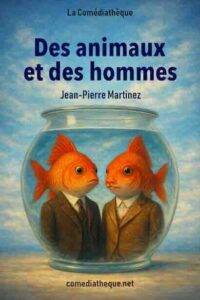
Des animaux et des hommes

Of animals and men –  De animales y hombres (español)De animais e homens (português)

Une comédie à sketchs de Jean-Pierre Martinez

De 2 à 40 hommes ou femmes

Fables contemporaines sur le monde comme il va… et surtout comme il ne va pas.


Ce texte est offert gracieusement à la lecture. Avant toute exploitation publique, professionnelle ou amateur, vous devez obtenir l’autorisation de la SACD.


TÉLÉCHARGER
PDF GRATUIT
ACHETER
LE LIVRE
ACHETER
LE LIVRE
amazon


Des animaux et des hommes Lire la suite »

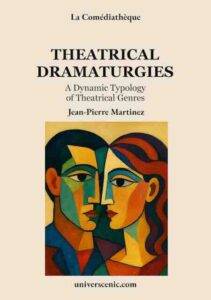
Theatrical Dramarturgies

One can perfectly well write a play without having studied dramaturgy, just as one can compose music by ear without ever having learned music theory. It simply means that one is instinctively applying the rules of harmony or dramaturgy. It does not mean that these rules do not exist.

Jean-Pierre Martinez, both linguist and playwright, casts an analytical eye on the history of theatre as well as on his own body of work, in order to map out theatrical genres, not as a normative system, but as a framework for reflection and an invitation to creativity.

With this brief essay, he seeks to share his theoretical and practical expertise in dramaturgy with all those who make theatre today, or who take an interest in it, whether as authors, directors or actors, but also as scholars, teachers, students… or simply passionate spectators.

DOWNLOAD
PDF FOR FREE

Theatrical Dramarturgies Lire la suite »

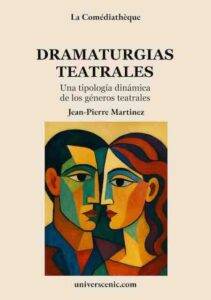
Dramaturgias teatrales

Se puede perfectamente escribir una obra de teatro sin haber estudiado la dramaturgia, igual que se puede componer una pieza musical de oído, sin haber estudiado solfeo. Eso significa únicamente que se aplican de manera instintiva las reglas de la armonía o de la dramaturgia. Pero no quiere decir que esas reglas no existan.

Jean-Pierre Martinez, a la vez lingüista y escritor, ofrece aquí una mirada analítica sobre la historia del teatro y sobre su propia obra dramática, con el fin de establecer una cartografía de los géneros concebida no como un sistema normativo, sino como una base de reflexión y una invitación a la creatividad.

Con este breve ensayo, desea compartir su doble experiencia, teórica y práctica, de la dramaturgia con todos aquellos que hacen el teatro de hoy o que se interesan por él: autores, directores de escena o actores, pero también investigadores, profesores, estudiantes… o simples espectadores apasionados.

DESACARGAR
EL PDF GRATIS

Dramaturgias teatrales Lire la suite »

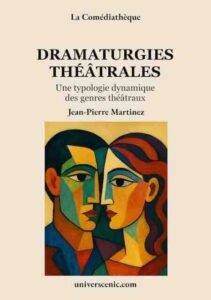
Dramaturgies théâtrales

On peut très bien écrire une pièce de théâtre sans avoir étudié la dramaturgie, comme on compose un morceau de musique à l’oreille, sans avoir étudié le solfège. Cela signifie seulement qu’on applique d’instinct les règles de l’harmonie ou de la dramaturgie. Cela ne veut pas dire que ces règles n’existent pas.
Jean-Pierre Martinez, à la fois linguiste et écrivain, pose ici sur l’histoire du théâtre et sur sa propre œuvre théâtrale un regard d’analyste, afin d’établir une cartographie des genres, conçue non comme un système normatif, mais comme une base de réflexion et une invitation à la créativité.
Avec ce bref essai, il souhaite partager son expertise à la fois théorique et pratique de la dramaturgie avec tous ceux qui font le théâtre d’aujourd’hui, ou qui s’y intéressent, en tant qu’auteurs, metteurs en scène ou comédiens, mais aussi comme chercheurs, professeurs, étudiants… ou simples spectateurs passionnés.

TÉLÉCHARGER
PDF GRATUIT
ACHETER
LE LIVRE
ACHETER
LE LIVRE
amazon

Dramaturgies théâtrales Lire la suite »

Horizons (english)

A comedy by Jean-Pierre Martinez

Translation by the author

In a desolate no man’s land that feels like a purgatory, three characters who have lost their memory stare toward the horizon, searching for answers to their existential questions. But which horizon is it, exactly? A tragicomedy blending science and philosophy, a reflection on the eternal cycle of life and death.


This text is available to read for free. However, an authorization is required from the author prior to any public performance, whether by professional or amateur companies. To get in touch with Jean-Pierre Martinez and ask an authorization to represent one of his works CONTACT FORM


DOWNLOAD
PDF FOR FREE

Abstract 

Horizons is a tragicomic meditation on consciousness, memory, and the limits of human understanding. Set in an undefined purgatorial space, the play follows three gender-neutral characters—Ben, Dom, and Max—who have lost their memory and face an ever-shifting horizon in search of meaning. Through their dialogue, Martinez turns the stage into a metaphysical laboratory where language becomes both a tool and a trap: a window onto the world and a cage enclosing thought.

Drawing on the legacy of Beckett and Ionesco, Horizons extends the tradition of the Theatre of the Absurd into the twenty-first century. Where Beckett’s Endgame ends in silence and Ionesco’s The Chairs in void, Martinez’s characters persist—still speaking, still questioning, still bound together by the need to make sense. Mixing humour, scientific imagery, and existential irony, the play transforms despair into cosmic curiosity. The horizon—optical, metaphysical, and linguistic—becomes the ultimate metaphor for the human condition: the endless pursuit of meaning just beyond our reach.

A comprehensive analysis in English of Horizons, by Jean-Pierre Martinez, with a particular focus on the characters, themes, structure, tone, and philosophical scope of the play.

HORIZONS

A tragicomic meditation on memory, language, and the limits of human understanding.


1. Overview

Horizons takes place in an undefined, liminal space — a “no man’s land that looks like a kind of purgatory.” Three characters who have lost their memory — Ben, Dom, and Max — find themselves together, staring toward a mysterious horizon that seems to shift, recede, or approach depending on their perceptions.

What begins as a comic, almost absurd situation soon evolves into a philosophical and existential reflection on consciousness, identity, and the cyclical nature of life and death. The horizon itself becomes a metaphor for the limits of human knowledge — both physical and metaphysical.


2. The Setting: Between Worlds

The action takes place on an empty stage bathed in an unreal light. The characters appear suspended between existence and non-existence, between life and death, between dream and reality.
This timeless and spaceless environment turns the play into a kind of metaphysical laboratory, where language is the only tool the characters have left to make sense of their condition.

The horizon — invisible yet omnipresent — functions as a moving boundary between:

the visible and the invisible,

the known and the unknowable,

the self and the other,

life and death.

It is both the limit of perception and the promise of transcendence.


3. The Characters: Mirrors of Thought

Although their gender is indeterminate (and the play explicitly allows for multiple casting combinations), the three characters — Ben, Dom, and Max — function less as psychological individuals than as personified facets of human consciousness. They can be seen as three voices within a single mind, or three different ways of relating to reality.

Ben — The Humanist and Mediator

Ben often acts as a bridge between the extremes. He questions, observes, and tries to make connections.
He embodies curiosity and empathy, but also a certain helplessness. He oscillates between hope and scepticism, between faith in meaning and awareness of absurdity.
When he says, “As long as we’re talking, we’re not dead yet,” he captures the essential human impulse to speak in order to exist.

Ben is the seeker of meaning — the part of us that cannot stop asking “why?” even when no answer comes.

Dom — The Ironist and the Rebel

Dom is the most cynical, sarcastic, and earthy of the trio. He constantly challenges the others’ assumptions and mocks philosophical pretension.
His humour is biting, and he often brings the conversation back to the absurdity of their situation.
At the same time, his rebellion hides a deep existential despair: the need to affirm his freedom in a situation where no freedom remains.

Dom is the voice of revolt — the part of us that resists resignation, that needs to laugh in the face of the void.

Max — The Thinker and Theorist

Max is the one who quotes physics, metaphysics, and philosophy. He’s fascinated by scientific metaphors: the curvature of the Earth, the event horizon, Schrödinger’s cat, black holes.
His reasoning is rigorous but sterile — he keeps trying to rationalize the inexplicable.
Through Max, Martinez caricatures the modern rational mind, endlessly analysing, naming, and conceptualising — yet unable to escape the prison of language.

Max is the intellect — the voice of reason that ultimately confronts its own limits.

Together, these three create a triangular dynamic:

Ben connects,

Dom destabilises,

Max explains.

Their dialogue becomes a theatrical dialectic — a back-and-forth between sense and nonsense, hope and despair, language and silence.


4. Structure and Dramatic Progression

The play unfolds in four short scenes, each marking a shift in perception or awareness.

Scene Setting / Event Dramatic Function
1 The three characters discover they are facing the horizon. They question what lies beyond and try to remember who they are. Establishes the situation and philosophical tone. The theme of memory and perception emerges.
2 Memories resurface — fragments of planes, hospitals, and disasters. Introduces doubt: are they dead, dreaming, or in a coma? The “event horizon” metaphor appears.
3 Hypotheses multiply: were they mountaineers, astronauts, or patients? The dialogue becomes a cosmic allegory — identity dissolves into collective consciousness.
4 Dom decides to walk toward the horizon. The others join him. They tie themselves together and move toward the audience. The metaphysical finale: hope, irony, and the cyclical return of existence.
Each scene redefines the meaning of the horizon — as optical illusion, boundary of death, scientific limit, and finally as a threshold of renewal.


5. Themes and Motifs


The Horizon as a Metaphor

The central image represents:

The limits of perception (scientific: the curvature of the Earth);

The limits of life (death as the horizon we cannot cross);

The limits of knowledge (language as both window and cage).

Every attempt to define the horizon pushes it further away — just as every attempt to define truth or meaning only multiplies perspectives.

Language and its Limits

The play continually reflects on the power and impotence of words.
Dom calls language “a grid that traps us inside the only reality our senses can perceive.”
Max tries to explain existence through science and logic.
Ben keeps using metaphors, even when he realises they might be meaningless.
Ultimately, their speech becomes a loop — a self-referential performance of thought chasing itself.

 Life, Death, and Rebirth

Drawing on both Eastern and Western philosophies, the play suggests a cyclical conception of existence.
Whether in a plane crash, a hospital coma, or a spaceship drawn into a black hole, each scenario symbolises the transition between worlds, the eternal recycling of energy — “the great recycling.”

Death, in Horizons, is not an end but a change of state — like matter or light disappearing beyond the event horizon.

 Memory and Identity

Having forgotten who they are, the characters must reinvent themselves.
Their amnesia becomes a metaphor for human finitude: we define ourselves through memory, but memory itself is unreliable and selective.
In the end, forgetting everything might be the ultimate freedom — “At least we’ll have forgotten everything, and we’ll be able to marvel again at being alive.”


6. Tone and Style

The tone oscillates between:

Philosophical gravity (discussions of consciousness, death, the universe),

Absurd humour (wordplay, irony, mock-science),

Poetic lyricism (repetitions, musical phrasing, imagery).

Martinez masterfully blends existential theatre (Beckett, Ionesco) with a lighter, more ironic touch, producing something accessible yet profound — a tragicomedy of metaphysical bewilderment.


7. Symbolic Ending

The ending — where the three characters tie themselves together and walk toward the horizon — can be read as:

a gesture of solidarity in the face of the unknown,

a metaphor for humanity’s collective journey toward its own limits,

and a final ironic twist: as the lights fade, they never reach their “Saviour,” yet keep faith all the same.

The horizon of events thus becomes the horizon of theatre itself — the edge where illusion and meaning dissolve into darkness.


8. Conclusion

Horizons is both a metaphysical fable and a play about language — a poetic confrontation with the unknowable.
Jean-Pierre Martinez uses humour, repetition, and paradox to explore the great questions:
Who are we? What lies beyond? Why do we speak at all?

Through Ben, Dom, and Max, he stages the eternal human dialogue between faith, doubt, and reason — between the desire to know and the impossibility of knowing.

The result: a luminous, ironic, and profoundly human meditation on the limits of existence — and on the infinite horizons that still lie beyond them.

Horizons (english) Lire la suite »