A comedy by Jean-Pierre Martinez
Translation by the author
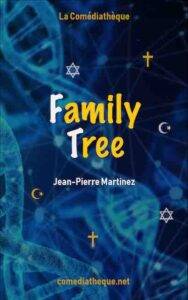
The time has come for Diana to introduce Khalid, her fiancé, to her parents. Annoyed by the patronizing attitude of his future in-laws, who appear excessively proud of their French lineage tracing back to the Middle Ages, Khalid teasingly challenges Diana to validate the authenticity of her ethnic heritage with a DNA test. The astonishing results of this test will set in motion a cascade of unforeseen events…
This text is available to read for free. However, an authorization is required from the author prior to any public performance, whether by professional or amateur companies. To get in touch with Jean-Pierre Martinez and ask an authorization to represent one of his works CONTACT FORM
The song from the play. Lyrics and music Jean-Pierre Martinez. This song may be used as part of a stage production, simple request to the author and without any additional fees. The audio file is available upon request, subject to prior authorization from the author for the use of the play’s text.
A Comedy Mocking the Myth of Noble Origins
Diane tells her parents that she is going to marry Karim, a Frenchman of Moroccan descent. In this Catholic, conservative family, fiercely proud of a French lineage supposedly stretching back to the Middle Ages, the news is greeted with a reserve that is difficult to conceal. Irritated by their prejudice, Karim challenges Diane to test the “purity” of her own ancestry through a DNA test. What was meant as a simple provocation ends up opening a Pandora’s box and shaking a number of firmly held convictions.
The play is driven by a particularly effective comic mechanism. From the announcement of a marriage and a simple DNA test, revelation follows revelation, constantly reshuffling the roles. Those who viewed other people’s origins with suspicion discover that their own family history is far less straightforward than they had imagined. And Karim himself, who thought he could teach his future in-laws a lesson, eventually finds himself caught in his own trap.
Beneath the conventions of boulevard comedy and the misunderstandings surrounding identity, the play nevertheless raises a genuine question: what is it that makes a family? The most moving answer comes, paradoxically, from Édouard, the character who initially appears most attached to genealogy and the continuity of a bloodline. He reveals that he has always known Diane was not his biological daughter, yet has never regarded her as anything other than his daughter. Family ties then appear to be less a matter of chromosomes than a story of love, choice and what we pass on.
The play thus takes its blurring of identities to its logical conclusion: French, Arab, Catholic, Muslim or Jewish, every identity that seemed firmly established turns out to be more uncertain or more mixed than it first appeared. And when Diane finally announces that she is expecting a child, the question of origins gives way to that of the future. After spending the entire play trying to work out where they come from, the characters may finally understand that what really matters is deciding what they want to pass on.