A comedy by Jean-Pierre Martinez
Translation by the author
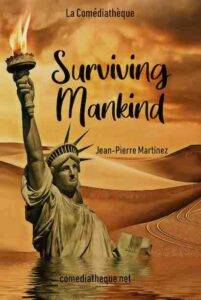
On a Planet Earth ravaged by climate change and rendered uninhabitable, mankind is living out its final hours. Two men and two women are set to take off in a spaceship for an unknown planet that might be their only chance for survival. The mission of these four « chosen ones » is to give humanity one last chance to save itself and carry on its evolution. But does mankind deserve a second chance if self-destructive madness caused its extermination? The passengers cannot agree…
This text is available to read for free. However, an authorization is required from the author prior to any public performance, whether by professional or amateur companies. To get in touch with Jean-Pierre Martinez and ask an authorization to represent one of his works CONTACT FORM
The songs from the play. Lyrics and music Jean-Pierre Martinez. These songs may be used as part of a stage production, simple request to the author and without any additional fees. The audio file is available upon request, subject to prior authorization from the author for the use of the play’s text.
After Us, the Deluge: Does Humanity Still Deserve to Be Saved?
On an Earth that has become uninhabitable, four survivors — two men and two women — are preparing to leave the planet aboard The Ark in the hope of allowing humanity to begin again elsewhere. But one question immediately casts doubt on their mission: after destroying its own world, does the human race really deserve a second chance? This disagreement gradually turns their last-chance journey into a confrontation between those determined to survive at any cost and those who believe it would be better to let humanity come to an end.
The play begins with an ecological catastrophe, but quickly moves beyond that single issue. Through its four characters, it confronts different ways of judging humanity. Alban condemns it for the crimes it has committed; Paul’s first concern is simply to save his own skin; Virginie refuses to give up on life, whatever happens; Ève wavers between these positions. Yet each of them is ultimately overtaken by their own fears, desires and contradictions. The debate therefore never simply sets good people against bad: it asks whether humanity should be condemned for what it has done, or still be given the freedom to choose a different path.
This is where comedy fully comes into its own. Even on the brink of extinction, the characters continue to joke, quarrel, flirt, grow jealous and make fools of themselves. The contrast between the enormity of what is at stake and the very human banality of their behaviour gives the play its distinctive tone. Humour prevents the argument from becoming didactic and reminds us that the humanity under discussion is never an abstract idea: it is embodied entirely in these four imperfect individuals, capable of both the worst and the best.
The ending takes this logic to its conclusion. Sixteen thousand years later, the survivors return to an Earth that has once again become partly habitable, as though history might begin all over again. The parallel with Adam and Eve is explicit, yet the play offers no innocent new beginning. On the contrary, it leaves unresolved the question running through the entire work: will humanity be able to avoid repeating its mistakes? Virginie’s final sacrifice provides only a provisional answer: despite everything that might justify humanity’s disappearance, perhaps there is still one reason to give it another chance.